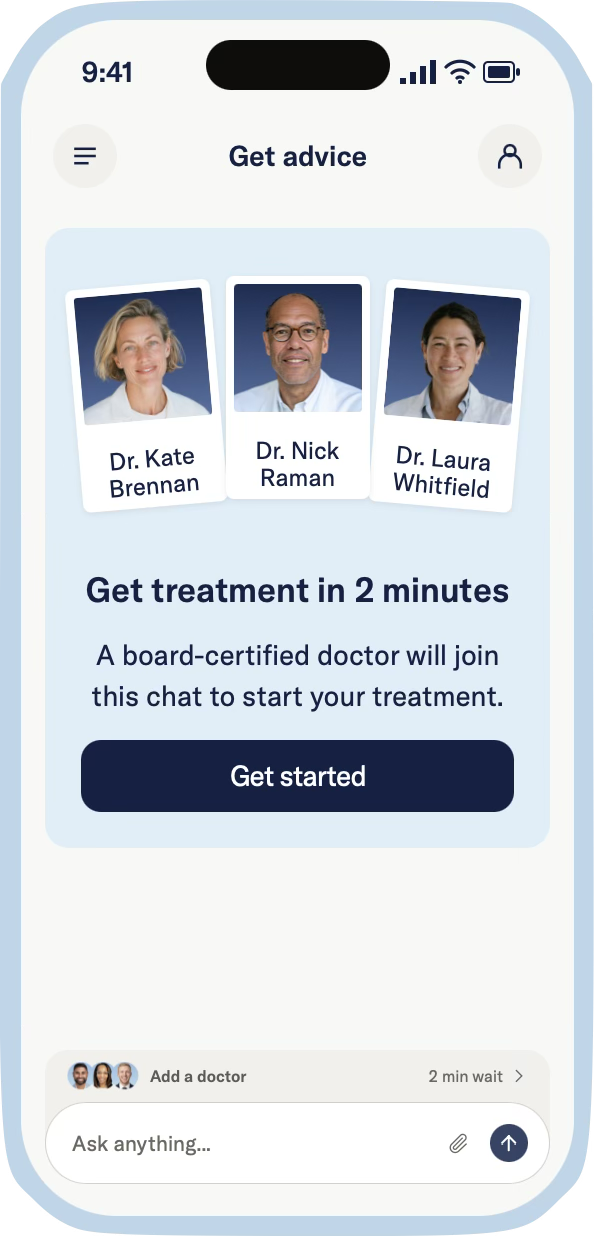
On November 10, Oura announced that it will buy Counsel Health for $625 million in cash, with the deal expected to close by the end of the year. Counsel is an AI-first primary care company. Its AI responds to the "member" (i.e. patient) first, then a physician can join the chat to diagnose, prescribe, or refer as needed.
Counsel has been operating for more than two years, and has been available inside the Oura app since June, in 43 states. They haven't disclosed revenue, and outside estimates run from under $1 million to a few million dollars. With about 70 employees their payroll already runs more than a few million dollars, even before counting any contract doctors, so I don't see any way that Counsel is even close to breaking even.
So Oura is spending one-third of its $1.75 billion 2026 revenue on a tiny, almost certainly unprofitable AI primary care company — in a world where primary care demand is shrinking.
Where did the visits go?
Primary care visits in the US have been going down for at least 15 years — though the physician workforce forecasts I wrote about in June don't include that fact in their models. The most detailed study on this is a 2020 paper in Annals of Internal Medicine by Ishani Ganguli and colleagues. They studied commercially insured adults aged 18 to 64 from 2008 to 2016. The study showed a 24% decline in primary care visits. The share of adults with no primary care visit in a given year rose from 38% — already high — to 46%. Low-acuity visits fell 48%. The drop was largest among young adults and people with no chronic conditions. In personal communications, Dr. Ganguli has told me that their later investigations extended those trends to 2023.
We see the same pattern in other datasets. National Ambulatory Medical Care Survey data show primary care visits per capita falling for years. HCCI commercial claims data and Medicare claims show the same direction. A 2026 analysis of traditional Medicare found an 11% drop in primary care visits between 2017 and 2023.
So why, in a world of shrinking primary care demand (likely to accelerate as GLP-1s drive down obesity), is Oura buying a tiny AI primary care company?
Why buy it? And why not.
Oura's CEO, Tom Hale, gave the company's reason: Oura helps members "understand their physiology and, with Counsel, they can take action on their health." But Oura customers already had access to that with Counsel available in the Oura app. It doesn't explain why they want to buy now when they've been renting.
1 - It's buying the doctors [but we need doctors for less and less]. As AI takes over much of the work of primary care, you still need a licensed provider to diagnose, prescribe, and refer. Counsel has docs to do that in all 50 states. ChatGPT Health does not. That's Hale's own framing: Counsel's doctors move Oura from "insights and knowledge and data to action."
But Utah's AI prescribing pilots and FDA's new path for app-screened over-the-counter drugs mean we're going to need fewer doctors to prescribe in future. Meanwhile, Oura is stuck with a physician group that doesn't scale and is less relevant with every passing year. And as a larger percentage of Oura's customers do not need the human doctor, Oura becomes one more AI health chat company — up against the likes of ChatGPT, where more than 300 million people are already asking health questions every week.
2 - It's buying the connections. Counsel sells direct to consumers, but also to health plans, health systems and employers, and since September to Medicare through ACCESS, which pays for measured improvement in blood pressure, cholesterol, A1c and weight. Oura may think those connections and corporate customers will help it win the ongoing battle of the wearables, with rivals like RingConn and Ultrahuman gaining ground. Alan Huynh notes that insurer contracts could bring in new customers, and venture investor Michael Greeley told MedCity News that a clinical offering could support longer customer relationships.
But how many connections and corporate customers could Counsel possibly have with a few million dollars in revenue at most? And Oura already had the most promising connection, Medicare, without owning anything: Counsel named Oura its preferred wearable partner for ACCESS in September, two months before the acquisition.
3 - It’s buying the integration and the data loop. Counsel was already inside the Oura app, but ownership lets Oura better integrate ring biometrics into the medical AI and the clinician interace, and own the data rights that improve the models over time.
But the core user value — chat, escalate to a doctor, prescribe or refer — was already available to Oura users. Tighter integration doesn't make up for decreasing demand.
4 - It's buying a story. Oura postponed its IPO on September 29. They may think that in a tough IPO environment (sorry, Anthropic!) a ring company with a clinical arm combining AI and doctors would be easier to sell to investors than yet another wearable company. Huynh makes the same case: "wearables plus clinical AI" is a better basis for a valuation premium than a ring company with great retention.
But we won't know if that moves the market until Oura revives its IPO.
5 - It's buying a GLP-1 channel. Eli Lilly promotes Counsel as a telehealth option for GLP-1 prescriptions, Lilly has invested in Oura, and more than 250,000 Oura members have turned on the ring's GLP-1 Insights feature. Unlike primary care, GLP-1 prescribing is growing fast, and more and more of it is done by DTC clinics and apps like Counsel.
But as noted above in #1, Oura can already send its members to Counsel without buying it.
Maybe . . . Oura doesn't know
There’s another possible reason for the deal: Oura may simply not know primary care is shrinking. Its own announcement points that way: Hale blamed the difficulty of getting care partly on "a shortage of doctors" and Oura's post warns the US could be short as many as 86,000 physicians by 2036.
How could a smart person like Hale think we have a doctor shortage while multiple sources confirm that primary care is, well, collapsing?
I don't know, but he's in good company. We live in a world of people claiming doctor shortages, and noting long waitlists for appointments (at least in big coastal cities) as evidence of increasing demand for doctors. And over the last five years I’ve talked with hundreds of health system CEOs and hundreds of primary care doctors, and none of them knew. Not one had read Ganguli's study, or heard of it.
So we have to at least entertain the possibility that Oura thinks it's buying into a growing market when that's not what's happening.
For forty years, care has been migrating out of the clinic. Knowledge, Diagnosis, Treatment, Monitoring and Interpretation — the Five Migrations — have been moving to patients and the tools they carry, and AI is speeding that up. Demand Elimination, starting with GLP-1s, is removing some of the conditions doctors used to treat. The work moving fastest is work that's only an exchange of information, which describes much of primary care and a good share of specialty care.
Most health and health tech companies haven't noticed. Like the CEOs and doctors I've talked with, they plan around shortage projections that assume demand will keep rising. Companies working from that premise will overpay for practices, clinics and doctors whose work is leaving. Oura may be the first wearable company to make that mistake, and I expect others across healthcare to follow.