The $50B Measurement Blind Spot in Healthcare Strategy
I speak with at least 100 healthcare leaders each year—CEOs, board members, C-suite execs. They all tell me the same thing: they’re tracking everything. Length of stay. Readmission rates. OR utilization. Revenue cycle velocity. Inpatient to outpatient volume shifts.
The one thing they’re not tracking at all? The demand leaving the system entirely.
A finding that should have set off alarms
In 2020, Harvard researcher Ishani Ganguli and colleagues published data in the Annals of Internal Medicine that should have reshaped healthcare strategy: from 2008 to 2016, primary care visits among commercially insured adults dropped 24%, with adults 18–34 showing the steepest decline at 29%. Preliminary data presented at AcademyHealth 2023 Annual Research Meeting suggest the decline continued through at least 2021.
Now imagine Ford discovering car sales had dropped 24%. Every analyst would track monthly figures. Every dealership would know. The board would have real-time dashboards.
Healthcare’s response? There was none. Recently, at a conference of hospital executives and board members, I asked the room if they were aware of this research. Blank stares. No one had seen the data.
Where’d they go?
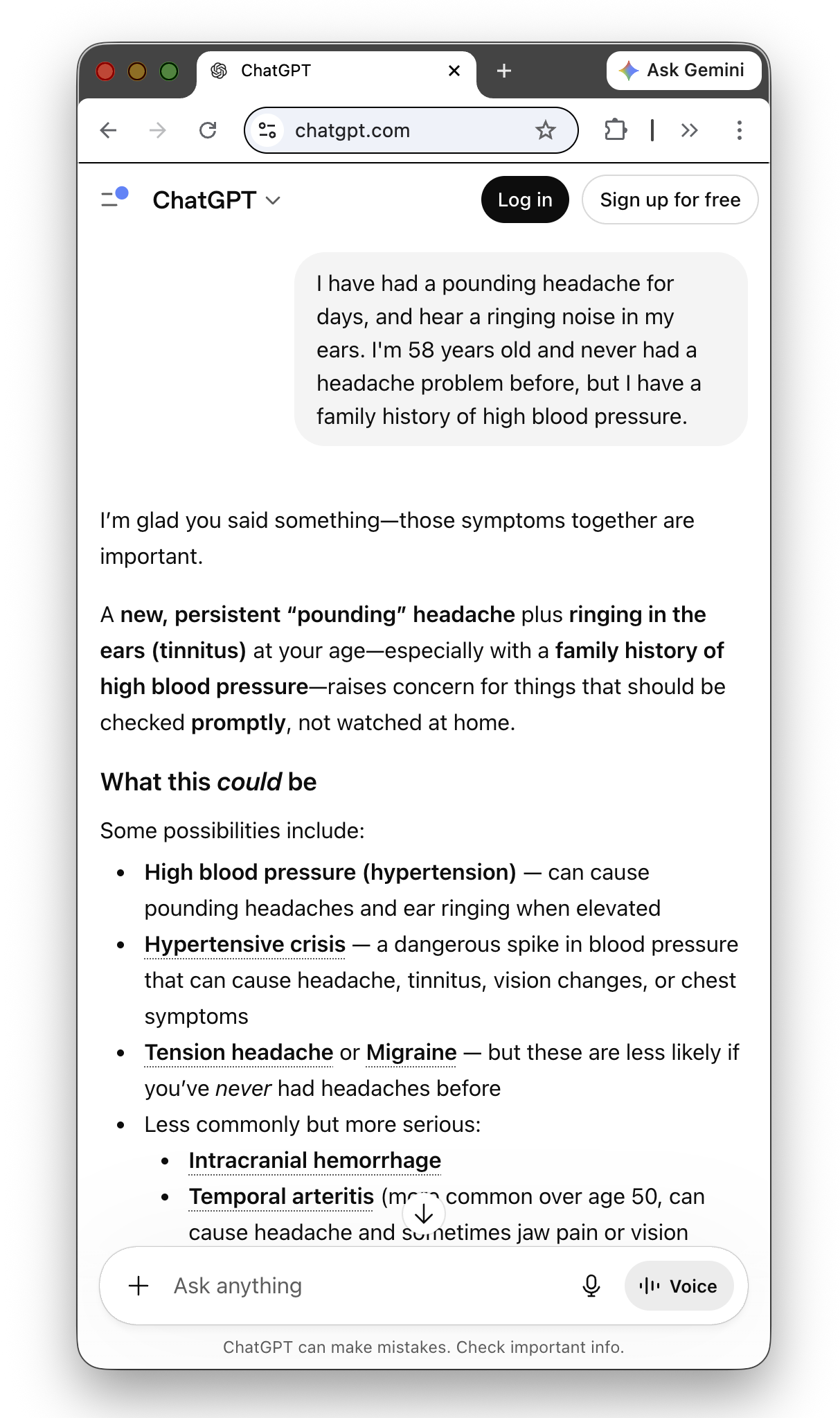
Demand leaving the system
The researchers tried to track where patients went instead of to primary care. What they found:
Alternative venues: Urgent care, retail clinics, ED, telemedicine. Still provider-mediated, still billed to insurance, still visible in claims. This accounted for about one quarter of the decline.
Everything else: Three quarters of the decline didn’t show up in claims at all — leaving the researchers unable to determine from claims data alone where that demand went. It could include three very different things:
Forgone care — people skipping treatment because of cost or access barriers. The authors pointed out that copays for problem-based visits increased 32% over the study period, and the visit decline was steepest in lower-income areas—suggesting cost might indeed be a factor.
Self-pay provider care (Hims, Ro, cash-pay telehealth) — still a clinician, but invisible to insurance.
Provider-less care — symptom checkers, WebMD, Apple Watch, ChatGPT. The authors noted that patients (especially younger patients) “accustomed to convenient, on-demand services in other aspects of their lives” were increasingly comfortable with “Internet-based health information, symptom checkers, and virtual patient communities” that “may preclude seeking formal medical care altogether.”
Although we first learned of this puzzle six years ago, we still don’t know the breakdown among these three categories. And we’re not even trying to find out.
The fifty-billion-dollar question
Primary care spending in the U.S. runs roughly $300 billion a year. A 24% decline represents over $70 billion in missing visits—and three quarters of that is unaccounted for. That’s a fifty-billion-dollar question: where did all that demand go?
If people are forgoing care entirely because of cost or access barriers, that’s a coverage, affordability, and capacity problem. Health systems might respond with sliding-scale pricing, expanded charity care, advocacy for better insurance coverage, or investments in scheduling capacity and workforce.
If they’re shifting to self-pay provider care—companies like Hims and Ro, which can generate billions in revenue on subscription models outside traditional reimbursement—that’s competition.
If they’re moving to provider-less care—handling health questions with ChatGPT, monitoring their hearts with Apple Watches, managing anxiety with apps—that’s a different threat entirely. That demand may never come back. No pricing strategy or convenient hours will recapture someone who’s decided they don’t need a clinician at all.
Each scenario has massive implications—for health systems planning workforce and capital investments, and for policymakers setting coverage and cost-sharing rules.
The measurement blind spot

Researchers have studied pieces of this puzzle—DTC telehealth utilization, consumer health tech adoption, cost-driven foregone care. But studies show DTC often drives new utilization (88% in one analysis) rather than direct substitution, and recent reviews highlight gaps in understanding system-wide impacts. No one has connected the dots to answer the strategic question: of the $50 billion in missing primary care demand, how much is going where?
How many diagnoses did Apple Watches make last year? Apple knows. Kaiser doesn’t. How many people skipped a primary care visit because of a $50 copay? How many used Hims instead of their PCP?
The data to answer these questions likely already exists—in surveys, in tech platforms, in self-pay provider records. But no one in healthcare is combining it, analyzing it, or acting on it.
This is the measurement blind spot at the center of healthcare strategy. Executives obsessively monitor demand shifting within their systems. What they don’t track, at all, is demand that leaves the system—or why.
Time to start measuring
We don’t yet know the split among cost barriers, self-pay competition, and consumer tech—but we need to find out. And right now, it’s not anyone’s job.
Each of those three possibilities demands a different response — and without knowing which one dominates, no rational response is possible. Every health system CEO should be asking: Of the demand that’s left your system, how much was lost to cost barriers, how much to self-pay competitors, and how much to provider-less care? If you can’t even estimate the split, you’re making billion-dollar capital allocation decisions blind.
Answering this will require new data sources—patient surveys, DTC partnerships, self-pay records, consumer trend analysis. But healthcare ignores this sea change at its peril. The organizations that start measuring now, and building strategy around what they find, are much more likely to be the ones still standing in 2035.