Notes: Cervical Cancer Screen Without the Clinic
The Teal Wand
Consumer health startup Teal Health raised $22 million last month to get more women screening for cervical cancer at home with their Teal Wand.
Starting in the 1940s, cervical cancer screening in the US meant a Pap smear: women booking a visit, taking time off, undressing, and lying back, feet in stirrups, while a clinician inserted a speculum and collected cells from the cervix. HPV testing was later added as the preferred test, but the visit and the speculum stayed.
80+ years later, in May 2024 the FDA let women swab themselves, but only in a health care setting. No speculum, but you still had to take time off work, go to the clinic, etc.
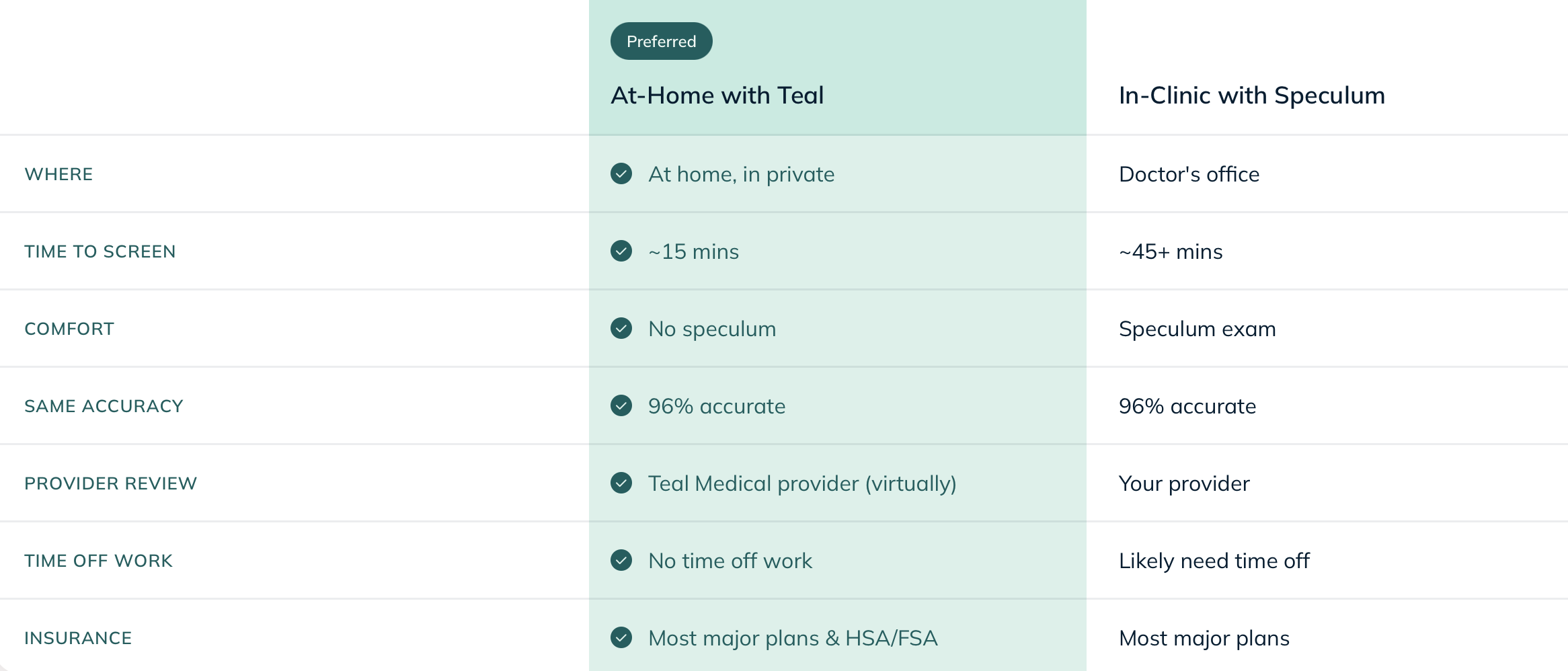
Then, on May 9, 2025, the FDA authorized the Teal Wand, which lets a woman collect her own vaginal sample at home and mail it to a lab for HPV testing.
No doc, no clinic, no time off.
Now insurers have to pay for DIY
In January, HRSA updated its guidelines for women's preventive care to include self-collected HPV testing. Under the Affordable Care Act, that means most private insurance plans have to pay for it, with no patient cost, starting in 2027 — including any follow-up tests, like colposcopy, needed after a positive result.
Teal already works with Aetna, Cigna, Blue Cross Blue Shield, and UnitedHealthcare. Those plans pay for the prescription, the lab, and the results, but not the kit or the mailing, so women pay $99 with insurance or $249 without. Next year women on those plans and others will pay nothing.
Does it work?
Yes.
In Teal's own study, published in JAMA Network Open, about 600 women swabbed themselves and then had a clinician collect a sample too. The self-swab caught 95% of the HPV infections the clinician's sample found, and caught precancer just as well.
Older research had similar results. A large 2018 review found self-swabs work about as well as clinician samples. Mailing kits to women's homes more than doubled the number who got screened, but making women request a kit didn't help much.
Teal today works the second way: a woman orders her own Wand — pull, not push, so that alone shouldn’t increase screening numbers. But Teal says the Series A will fund partnerships with insurers, health systems, and employers — who could mail kits to everyone and bump up those numbers.
What still needs the clinic
The lab tests the swab for high-risk HPV, the virus behind nearly all cervical cancer. If it's negative, the woman should screen again in three years. If it's positive, she goes back to the clinic for more testing, often colposcopy, where a clinician magnifies the cervix and biopsies anything suspicious. So followup is always in-clinic.
Also: the Teal Wand is only for average-risk women aged 30–65. Women under 30 and high-risk women also are always screened in-clinic.
Bottom line: Teal is classic Diagnosis Migration to the consumer sector, but follow-up diagnosis and treatment remain in the clinic.
Who gains
The women who gain most are those who haven't been screened at all, or not recently, and this is an increasing number of women. The share of US women 30–65 overdue for screening rose from 14.5% in 2005 to 21.1% in 2019, per a 2022 JAMA Network Open study. Teal says 59% of its users are underscreened, and its CEO told Fierce Healthcare that it finds cancer at about five times the rate expected in general screening. Those are from the company itself, but I think that’s about what you'd expect if the test can reach the women who aren’t getting traditional screening.
Will she miss the annual visit?
If women using Teal skip visits, which they very likely will, what do they lose? Teal's telehealth visit covers eligibility, the prescription, results, and coordination of follow-up. It doesn't do a pelvic exam, take a blood pressure, give vaccines, or handle contraception, STI testing, or mammogram referrals (at least not that it mentions on its site).
First: routine pelvic exams have no strong evidence to support it: USPSTF found the evidence insufficient to recommend for or against it, and the American College of Physicians recommends against it in asymptomatic women.
What about the rest of what's done at that annual visit? HRSA's own evidence update found no studies evaluating the effectiveness of well-woman visits (I should be shocked, but somehow I’m not). The closest evidence, a 2021 JAMA review, found no reduction in mortality or cardiovascular events, but better uptake of preventive services, more detection of conditions like hypertension and depression, and better blood pressure and cholesterol control.
Of course that was before hypertension-tracking wearables, DTC lab orders, and AI health coaches on our phones, so solve for the equilibrium, as the Marginal Revolution guys always say.
Who loses
That’s easy: gynecologists, plus the family doctors, internists, and NPs who do much of this screening. Good for their patients, but their offices will have fewer screening visits and fewer collection fees. Medicare's 2026 fee schedule pays $46.09 to obtain a screening Pap specimen (Q0091), plus $39.75 for a screening pelvic and breast exam (G0101), nationally, before local adjustment. Most women 30–65 have commercial insurance, which usually pays more. So that is on the line.
One offset, maybe: more women screened means more positives, and every positive goes back to a clinician for follow-up and colposcopy.
Another loser: the healthcare system employing those clinicians, if there is one. As I wrote in When Medical Testing Becomes Free, once the test is cheap or free, value shifts to whoever owns the relationship with the patient.
Which in this case will be Teal.