When Medical Testing Becomes Free
This is Part II of a two-part series. Part I explored how software can extract new information from medical tests we already take. This part looks at what happens to the economics and business of testing as software eats testing..
HealthCCSng, an awkward name even by medical-software standards, is an AI system developed by Zebra Medical Vision, now part of Nanox.AI. It analyzes routine chest CT scans and estimates coronary artery calcium, a marker of coronary artery disease. The CT may have been done to look for lung cancer, pneumonia, or something else but if it includes the heart, the software can use the existing images to run an additional cardiovascular test.
The FDA summary reports validation on 447 CT scans from two healthcare institutions, using three radiologists' majority opinion as the gold standard. We also know that 245 days elapsed between the FDA submission and clearance.
We can't tell from public records what HealthCCSng cost to develop and validate. Presumably, it wasn't cheap, but once the software has been validated the cost to run it on a scan is negligible: no scanner, no staff, no appointment, no radiation. It just looks at the scan that was already done.
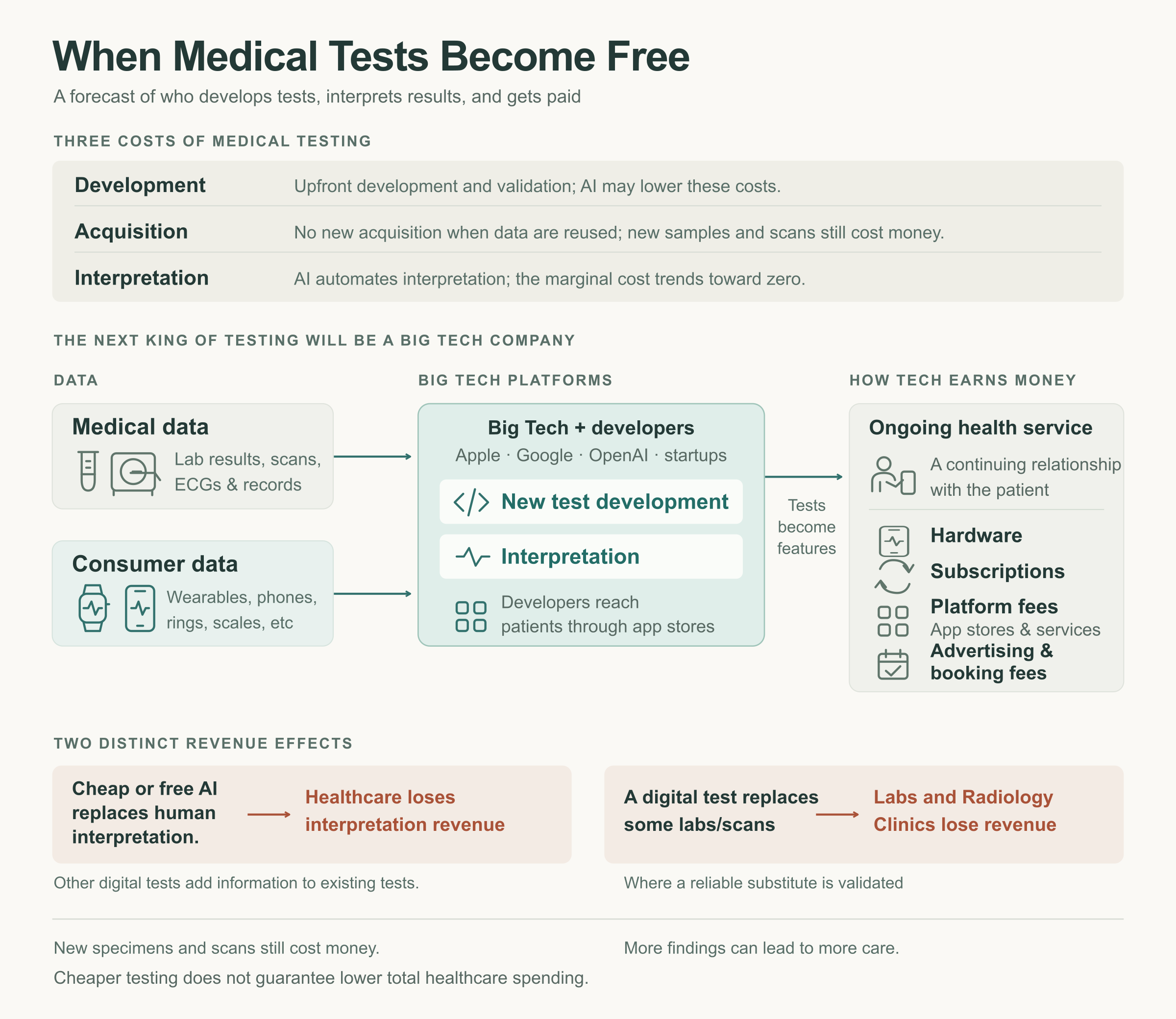
As medical testing becomes digital, and costs plummet, its economics increasingly favor companies well-versed in digital business models — just as happened with phone calls, photography, recorded music, travel reservations, etc ad infinitum. As that happens, Big Tech and tech startups will increasingly dominate the development of new health tests and the interpretation of those and traditional medical tests and scans. Healthcare providers will lose revenue from interpretation as that work moves to consumer technology services. Laboratories and imaging centers will also lose revenue as new digital tests replace some of the conventional tests they sell.
When the test stops being the product
Email is a good example of how digitization changes economics. In 1983, MCI Mail charged $1 per message. In 1996, AOL charged by the hour, then moved to subscriptions. In 2004, Google launched Gmail as a free service to anyone with an internet connection.
None of those systems was free to build or operate. But as the marginal cost of sending another message fell, email providers stopped charging for individual messages. They sold network access, subscriptions, advertising, storage, hardware, business services, and a continuing relationship with the user. Today nobody ever considers the cost of an email before hitting send — or, similarly, the cost of a "long-distance call" (has anyone under the age of 30 even heard that phrase?).
Medical testing has three main cost elements: development, acquisition, and interpretation — and software can drive down all three. AI may reduce development costs by allowing companies to adapt models and infrastructure built for other purposes. When software runs on an existing scan, ECG, laboratory history, or sensor stream, the new test has no acquisition cost of its own, so that drops to zero. AI can also automate interpretation, reducing or eliminating the clinician time and the cost required for each additional analysis. As that cost trends towards zero, charging for each interpretation will start to look as strange as charging for each email.
What companies sell instead
A test that costs very little to run can be bundled with hardware, included in an AI subscription, given away to keep users inside an ecosystem, or used to sell another service. A company could charge an insurer for preventing admissions, take a share of savings, or get paid for achieving a health outcome.
Apple mostly wants to sell more hardware. It added hypertension notifications to watches already on users' wrists, using optical-sensor data already being collected. The new test arrived as software and costs the user nothing beyond the phone and watch (by now, smartphone users take it for granted that more features will be added by free software updates). Apple Health's AI interpretation adds more value still.
Google offers tiered pricing. Its free Google Health app combines health data from several sources; an additional $9.99 a month buys “Google Health Premium,” with coaching, readiness, and other features similar to Apple's.
OpenAI makes health interpretation part of a general AI service. ChatGPT Health can combine medical records and Apple Health data to explain laboratory results and identify patterns over time. Interpretation becomes a feature of the consumer's existing relationship with an AI service.
Another model would connect patients to care. Zocdoc already charges providers for new-patient bookings and sponsored placement. A tech company could offer free testing and/or interpretation and earn money from advertising and specialist bookings (subject to the Anti-Kickback Statute, which restricts payments for referrals involving federally covered care). A company paid for bookings would have a reason to turn findings into appointments, helping people obtain needed care but also potentially encouraging unnecessary follow-up.
The next king of testing will be a Big Tech company
Traditional healthcare has controlled which tests are ordered, where the resulting data are stored, and which interpretations reach the patient. Laboratories produce measurements, imaging centers produce images, and clinicians interpret the results.
Digitization can shift power from the company producing the underlying material to the company making a service from it. Twenty-odd years ago, musicians and labels still made the music, but Apple's iTunes Music Store became the dominant marketplace and helped sell highly profitable iPods. Apple captured the customer relationship and much of the value created by digitization.
Medical testing will follow the same path. Whoever has permission to use the data and the resources to develop new digital tests (i.e. new software) will own the next generation of medical testing.
Big Tech can disrupt medical testing in three ways:
Interpret existing tests. Consumer software like ChatGPT Health can interpret lab results and scans in the context of a person's medical history and also their everyday health data. That moves work and revenue away from the clinicians and healthcare organizations that currently sell interpretation.
Develop new tests for existing medical data. Software can extract additional signals from scans, ECGs, and digitized data from biological samples (as with HealthCCSng). The physical test still supplies the data, but a tech company can develop and provide the additional test, including for data collected years earlier, and capture the value of that additional test.
Replace conventional tests with software running on consumer devices. Apple's AirPods hearing test plays tones and uses your responses to produce an audiogram at home. In a 201-person validation study, its results closely matched audiologist-administered testing. You can obtain that hearing measurement without a clinic visit. Of course, this makes Apple hardware more valuable while displacing a paid test. The next step is algorithms that use everyday data from wearables, phones, rings, scales, and other consumer devices (i.e. not a specific hearing test the user has to stop and perform) to replace some lab tests or scans.
Competing with free
These activities create a competitive problem for the health systems, imaging vendors, and diagnostic-software companies that currently control how results are interpreted and delivered. They may hope to sell a new software test at a high margin — but a big tech company may be able to include a similar interpretation in a subscription the patient already pays for, or give it away. The tech giants can also quickly update their models across millions of users, while a hospital may wait months or years for its imaging vendor, budget cycle, regulatory review, and IT department to agree on an upgrade.
“How does a business built on selling tests or interpretations compete with a company that profits by giving them away?”
Laboratories and imaging centers will continue supplying data for tests that require specimens or new scans. New test development and interpretation will increasingly happen on platforms controlled by Big Tech, either through algorithms developed by Apple, Google, OpenAI, and their peers or through smaller diagnostic-software companies selling services in their app stores. Existing diagnostic companies may need those platforms to reach patients. Either way, Big Tech controls the customer relationship and takes a share of the value.
The bottom line: companies whose revenue depends on selling tests or interpretations will have to compete with companies that can profit by giving them away.
The next ten years
The postal service still delivers physical letters to physical mailboxes, and healthcare still uses fax. Hospitals will continue ordering and interpreting tests, trying to charge familiar prices even as software reduces their costs. For a shrinking share of the population, that will remain the only way medical testing happens.
Increasingly, though, people will order their own laboratory tests, obtain copies of their scans, and ask their phones and computers to interpret the results. More tests will come from Big Tech and from startups selling through the app stores.
The cost of testing will surely decrease as more becomes digital, but that may not reduce the costs of healthcare, as more findings may lead to more visits, procedures, and treatment — though more of the treatments may also be provided by tech companies (see today's announcement by Nolla Health of their pilot in Utah to diagnose, prescribe, and followup patients with acne — with no human clinician involved).
For traditional labs and healthcare providers, the question will be: how does a business built on selling tests or interpretations compete with a company that profits by giving them away?