AI Is Already Practicing Medicine
Last week on LinkedIn, surgeon Erin Palm and I had an exchange. She posted, alongside a photo of a doctor in scrubs with a pager:
In Silicon Valley: We believe AI will be practicing medicine momentarily. Also in Silicon Valley: The technology used to notify the on-call trauma surgeon that an injured patient is arriving. Yes, I concede there is a gap in expectations vs reality.
Obviously, she's right that we live in a world of amazing advances in medical AI, while at the same time much of healthcare is mired in old tech. Point conceded.
But "will be practicing medicine momentarily" is wrong in using the future tense. AI is practicing medicine now. It has been, legally, since at least 2018, when the FDA authorized an autonomous system to diagnose diabetic retinopathy with no physician interpreting the result. And AI now renews prescriptions in Utah under state authorization, again with no physician signing off. In both cases the company producing the AI, not a doctor, carries the malpractice policy.
When I pointed this out, Dr. Palm answered:
I think we can debate the semantics of whether these tools are really "practicing medicine" yet. Let's not sell ourselves short by setting that bar so low.
But when I diagnose something in clinic, or prescribe a medication, or refill one, I am definitely practicing medicine — and if you did any of that without a medical license you'd be arrested.
So if a machine does the exact same things, how is that semantics?
What the practice of medicine actually means
Every state has a medical practice act, and they all include the same short list of acts a license exists to gate: diagnosing disease, prescribing or administering treatment, and performing procedures, generally for compensation. California's is representative — Business and Professions Code §2052 makes it a crime to diagnose, treat, or prescribe for any condition without a license. The Federation of State Medical Boards' model language reads the same way. None of these statutes mention empathy, a white coat, or bedside manner.
That's the bar — not mine, not Silicon Valley's. And three things have already crossed it.
The line has been crossed
| Defining act | System | Crosses the legal line? |
|---|---|---|
| Autonomous diagnosis | LumineticsCore (Digital Diagnostics) | Yes — FDA De Novo, 2018; no physician overread; vendor assumes liability; Medicare-reimbursed |
| Autonomous prescribing | Doctronic (Utah pilot) | Yes — state-authorized to issue renewals without a physician signature; vendor carries malpractice cover |
| Autonomous triage | Aidoc, Viz.ai | Partly — the software decides whose scan a radiologist sees first, based on what it found; a clinician still confirms |
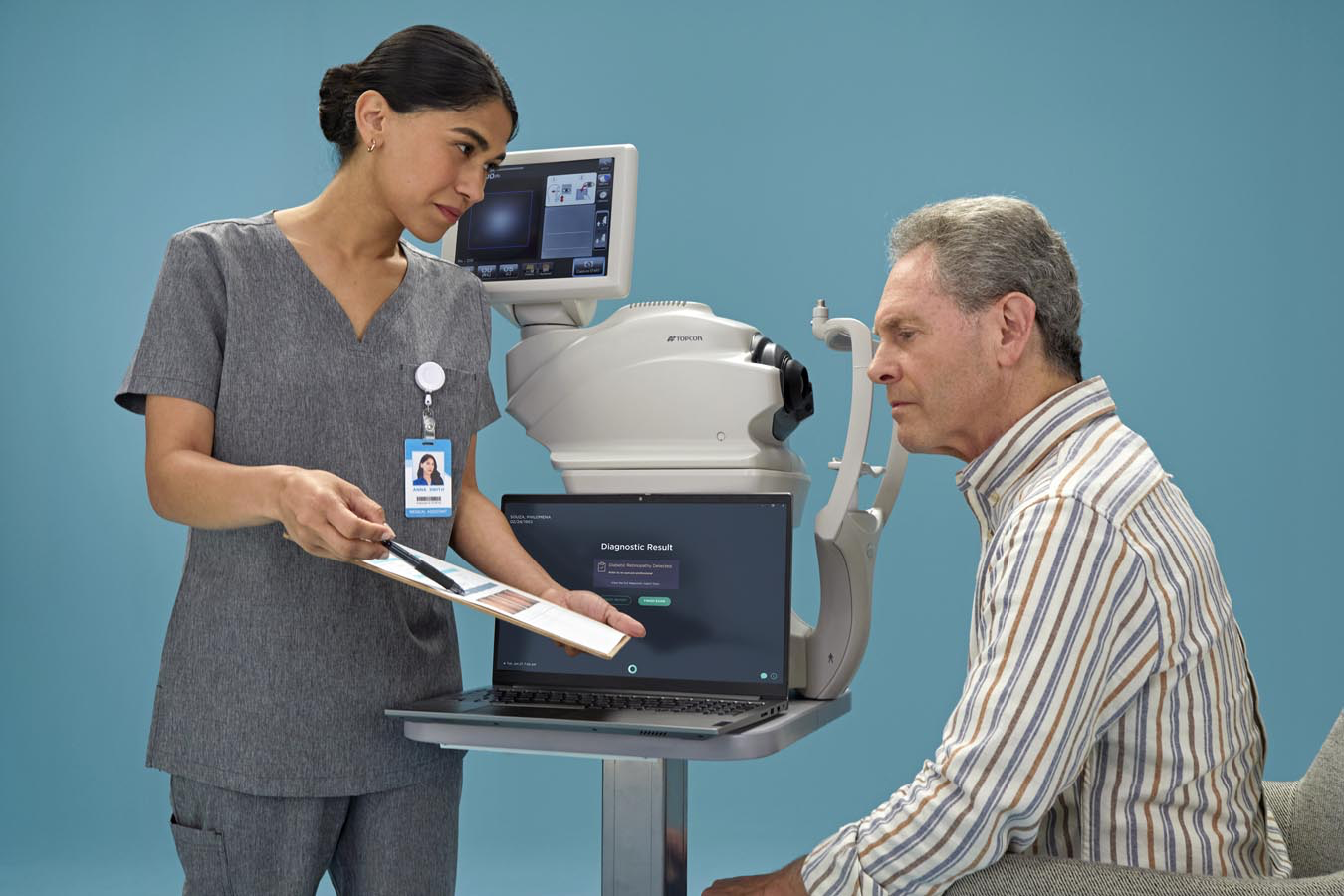
LumineticsCore
LumineticsCore, formerly IDx-DR, received FDA de novo authorization in April 2018 — the first clearance ever granted to an autonomous AI diagnostic system. A technician captures retinal images; the software returns a diagnosis of more-than-mild diabetic retinopathy "without the need for a clinician to also interpret the image or results," in the company's own words. The act that once required an ophthalmologist's judgment now requires none. Medicare reimburses it. Digital Diagnostics carries malpractice insurance on the output and assumes liability for the diagnosis — the company stands behind the result instead of an ophthalmologist.
In January 2026, Utah's Office of Artificial Intelligence Policy authorized the first state-approved program letting an AI system write prescription renewals. A patient verifies identity, confirms a prescription history, answers clinical questions, and — for medication classes past the program's validation threshold — Doctronic's AI issues the renewal and sends it to the pharmacy, with no physician involved. The pilot is limited: 191 routine medications, no controlled substances, physicians reviewing the early cases in each drug class. But once a class clears that review, the AI renews prescriptions in it without physician input. Doctronic holds a malpractice policy binding the system to a physician's standard of accountability, because the system does what a physician would normally do.
Aidoc and Viz.ai are the contestable case. Their FDA-cleared software scans medical images for signs of a stroke or a blood clot in the lungs, and when it finds one, moves that patient to the front of the radiologist's list. A radiologist still confirms the finding, so the machine isn't making the final call — but it is reading the image and deciding who gets seen first, on its own judgment. That is a piece of triage, work that has always belonged to clinicians. I'd call it a partial crossing and let the reader argue — but the first two rows are crystal clear.
The retreats
In my experience, once the examples are on the table, the objectors keep moving the goal posts, redefining "practice" to exclude whatever the machine just did.
It's only narrow. So is a dermatologist. Specialization has never disqualified an act from being the practice of medicine.
A physician is still ultimately responsible. Not with LumineticsCore or the Doctronic pilot in Utah.
It isn't making complex judgments. If a diagnosis that previously required a physician with at least 8 years of post-college education wasn't complex, why did it require that specialist? And if a machine starts making the same diagnosis, did it suddenly become less complex?
It's just a tool. Tools don't carry their own malpractice insurance. A company can only get medical malpractice insurance — as opposed to ordinary product liability — if that company's product is legally practicing medicine.
Why so much resistance
The resistance is understandable. Medicine's professional identity rests on the premise that certain acts require a licensed human.
Up to about 3 years ago, this identity manifested to me in the form of visibly angry physicians during the Q&A after my keynotes, insisting that "you can never replace the judgment of a physician with a machine."
I don't get as many of those questions anymore, as physicians seem more and more resigned to the power of AI in performing medical tasks.
But physician groups are still resisting now, under the guise of patient safety. For example, when Utah's pilot went live, the state medical licensing board demanded its suspension, writing that "there is a reason prescription refills require physician authorization," and in the process conceding that machines can write prescriptions — though, in their view, not safely.
The 2018 FDA authorization of LumineticsCore (then IDx-DR) drew no such letter: it does one narrow thing in one specialty, and few outside ophthalmology had cause to protest when a small, well-paid field lost a routine screening task. Prescription refills reach all of primary care, and the alarm has grown accordingly.
And it's just getting started
The acts that define medical practice are migrating to machines — under FDA authorization, with vendor liability, billed to Medicare. It began with two of the most consequential acts a physician performs, and it will not stop there. And this is only the migration happening inside the clinic — the larger one is just starting, as more and more physician tasks move not to the AI a hospital buys but to the AI a patient already carries. That's a subject for another piece. Healthcare is getting better, and getting smaller, and the smaller part begins with the acts physicians used to own.