The Most Important Number Your Doctor Has Never Measured
There’s a number that predicts whether you’ll be alive in ten years better than your blood pressure, your cholesterol, your BMI, or whether you smoke.
It’s called VO2 max.
You’ve probably never heard your doctor mention it.
The number
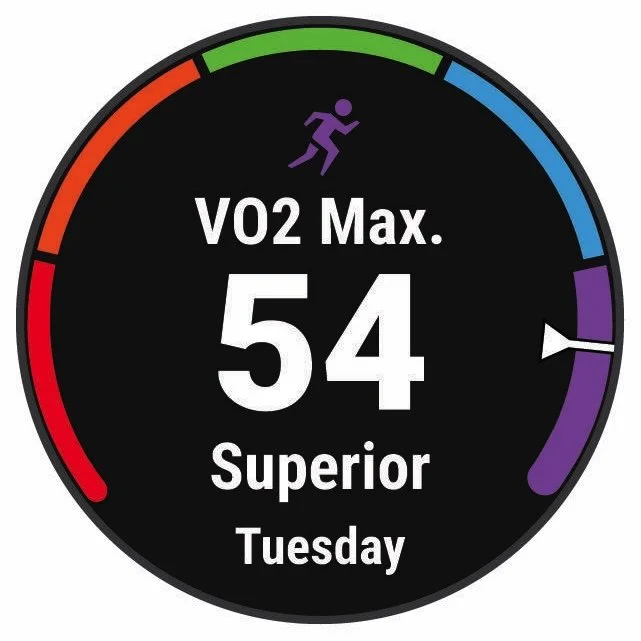
VO2 max displayed on a Garmin watch
VO2 max measures the maximum amount of oxygen your body can use during intense exercise. It’s a single number — reported in milliliters of oxygen per kilogram of body weight per minute — that captures how well your heart, lungs, blood vessels, and muscles work together. Researchers call the broader concept “cardiorespiratory fitness,” or CRF. VO2 max is how you measure it.
And it may be the single most powerful predictor of whether you live or die that medicine has ever identified.
In 2022, a study of more than 750,000 U.S. veterans found that even modest improvements in VO2 max were associated with a 13 to 15 percent reduction in mortality risk. Regardless of age. Regardless of BMI. Regardless of sex or existing conditions.
A 46-year follow-up of over 5,000 men in Copenhagen found that each 1 ml/kg/min increase in VO2 max was associated with 45 additional days of life.
A 2018 Cleveland Clinic analysis of 122,007 adults found that those with the lowest VO2 max had four times the mortality risk of those with the highest. And the benefit curve never flattened — fitness kept paying dividends well past “fit” into “elite.”
To put that in perspective: the mortality difference between the least fit and the most fit people in that study was larger than the difference between non-smokers and smokers. Larger than the difference between people with and without diabetes, or the difference between people with and without end-stage renal disease.
The recommendation no one followed
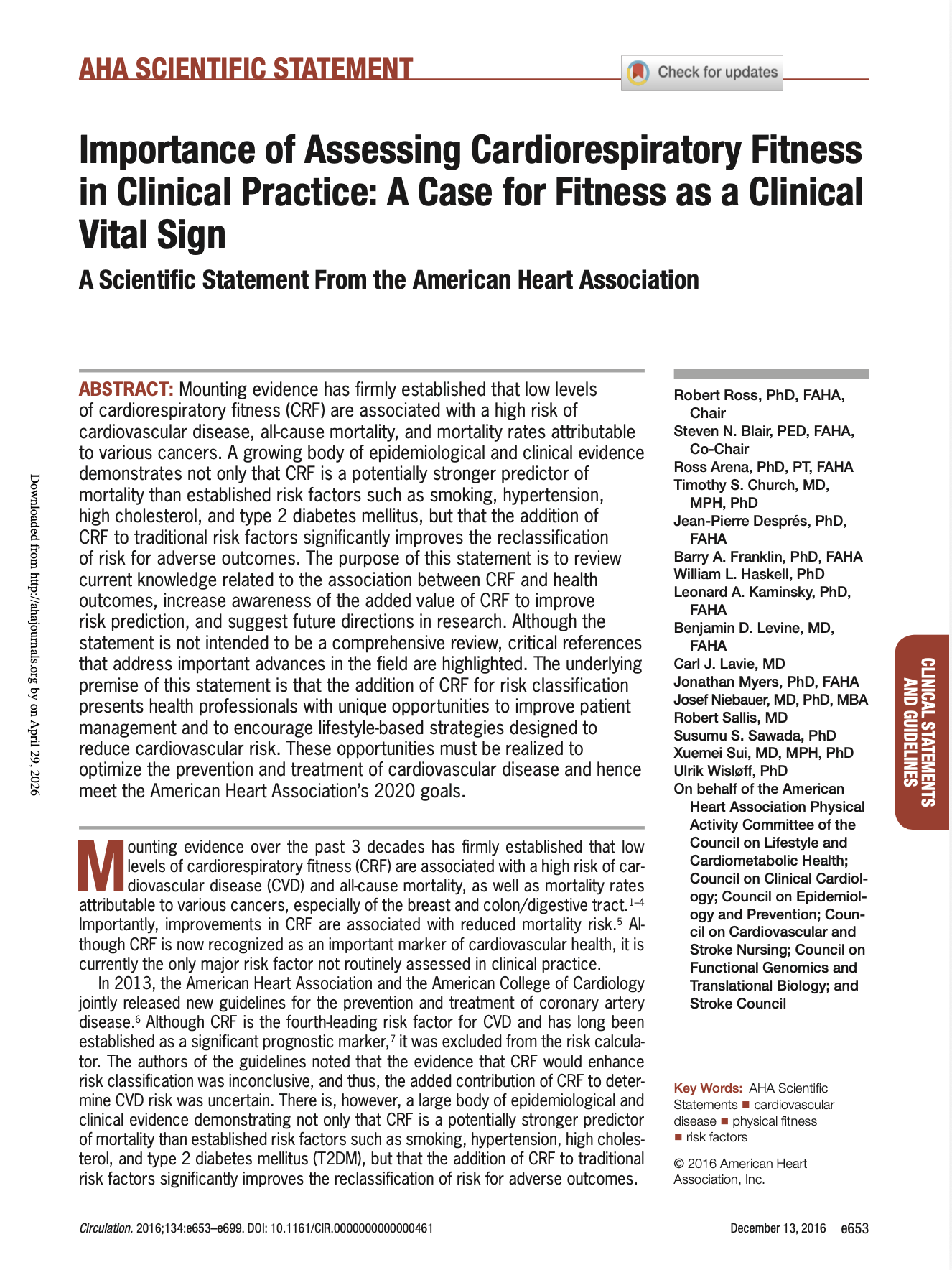
In 2016, the American Heart Association published a landmark scientific statement arguing that cardiorespiratory fitness should be treated as a clinical vital sign — measured routinely, right alongside blood pressure, heart rate, and temperature. Their recommendation was explicit: at a minimum, all adults should have their cardiorespiratory fitness estimated every year.
That was nearly ten years ago. Has your doctor ever measured it? Have they ever mentioned it?
Mine never has. And I’m a doctor.
The reason is straightforward. Measuring VO2 max accurately requires a graded exercise test — a treadmill or stationary bike, a face mask connected to a metabolic analyzer, a trained technician, and a patient willing to exercise to exhaustion. The test takes 10 to 15 minutes and costs $150 to $250. Not covered by insurance.
In other words, the single most powerful predictor of mortality we have doesn’t fit inside a 15-minute office visit. So it doesn’t get done.
A 2024 update to the AHA’s original statement acknowledged the problem, noting that despite overwhelming evidence, “inertia exists” with respect to integrating CRF assessment into routine care.
But it isn’t inertia that prevents VO2 max from being integrated into standard checkups. It’s financial reality dictating that there is absolutely no way to turn 15-minute visits into 30-minute visits without sinking the ship.
The migration
While the clinical system was busy not measuring VO2 max, someone else was — on millions of people’s wrists.
Apple Watch has been estimating VO2 max since 2020. It does this passively — using heart rate sensors and GPS data during outdoor walks, runs, and hikes. No mask. No technician. No appointment. Since late 2020, it has also been sending push notifications to users whose cardio fitness is consistently low enough to suggest health risk.
Apple validated its algorithm against gold-standard lab testing with 755 participants. The result: accuracy within about 1.2 to 1.4 ml/kg/min—roughly 4 percent of true value. About one in five Americans now wears a smartwatch or fitness tracker. Garmin, Whoop, Fitbit, and others estimate VO2 max too.
Is a wrist estimate as good as a lab test? No. A 2025 validation study found that Apple Watch underestimated VO2 max by a meaningful margin. Is it better than a gold-standard lab test that never gets done? Yes, yes it is.
But the wearables I’ve mentioned don’t just measure your VO2 max annually, as suggested by AHA. They measure it every time you take a brisk walk. And a wrist estimate taken hundreds of times over months and years is a different animal completely. It captures trends. Trajectory. Response to training. Response to illness. Seasonal variation. For a metric whose clinical value is largely about change over time, a less precise measurement taken continuously is almost certainly even more useful than a more precise measurement taken once a year.
Apple ad talking about the VO2 max measurement on the Apple Watch.
Last month, Apple ran a global ad campaign — Listen to your body. Not everybody — built entirely around the idea that your wrist now knows things about your health that nobody else does, not even your doctor. In essence, the many consumer electronics companies offering VO2 max estimation are running the public health practice that AHA offered but healthcare couldn’t make happen.
Beyond the system
I often talk about the “Five Migrations” of clinical tasks from the exam room to the living room: Knowledge, Diagnosis, Treatment, Monitoring, and Interpretation. But this isn’t a migration, because measurement of VO2 max was never in the exam room. This is not a story about consumer technology doing that isn’t quite as good as something healthcare does, it’s a story of consumer tech doing something healthcare is simply not able to do. Something very important for our health.
Worse, the system can’t even see that it’s happening. Wearable VO2 max estimates generate no insurance claim. No CPT code. No encounter. No entry in the medical record. When a 55-year-old woman gets a low cardio fitness alert on her Apple Watch, starts a HIIT program, and improves her VO2 max by 5 ml/kg/min — reducing her all-cause mortality risk by somewhere around 50 percent — that entire health intervention shows up nowhere in the healthcare system’s data. Her doctor doesn’t know. Her insurer doesn’t know. CMS doesn’t know.
For those healthcare execs and health policymakers that only count what the system measures — which is almost everyone — it didn’t happen.
This is the same blind spot I’ve written about before. Per capita healthcare spending growth has fallen from 83 percent per decade in the 1960s to 28 percent today. Primary care visits declined 24 percent between 2008 and 2016, with three-quarters of that drop invisible in claims data. The system is getting smaller. But the measurement apparatus can only see what happens inside the system. And increasingly, the most important things are happening outside it.
What this means
I check my own VO2 max on my watch. I’ve never had it measured by a physician — and I’ve never measured it for my patients. That’s an awkward admission, but it’s an honest one. And I suspect it’s true of most doctors and most patients.
The AHA was right in 2016. VO2 max might be the most important vital sign we have. They were right to recommend annual measurement. But they were recommending that a system built around 15-minute visits, fee-for-service billing, and passive diagnostic tools should suddenly start administering exercise tests to every adult in America. That was never going to happen.
What happened instead is that a consumer electronics company built the measurement into a device that 100 million people already wear, and started nudging the least fit among them toward behavior change. Nobody planned this as a public health intervention. No committee approved it. No pilot study preceded it.
And VO2 max isn’t the only example. It may not even be the best one. Clinical medicine was built around episodic encounters — because for most of its history, that was the only access it had to patients. Consumer technology doesn’t have that constraint. And in case after case, it’s starting to do things the clinical system can’t.
More on that soon.