AI Doesn't Replace Doctors. It Replaces the Reasons to See One
Danielle Ofri's NY Times essay last week ("I'm a Doctor. Here's What A.I. Cannot Do," May 5) is the latest entry in a decade-old genre: the physician essay explaining why AI can't replace doctors. Ofri is a beautiful writer, and her story of the 86-year-old in the waiting room is a moving anchor for her argument that wisdom, character, and the long doctor-patient relationship are things AI cannot touch.
She is also answering a strawman.
The real question — the one hospital systems, medical schools, and workforce planners need to answer — is not whether AI will “replace doctors”. It is how many physicians we will need as the set of tasks that only physicians can perform are dramatically reduced. Barring some additional development, the answer is many fewer.
The framing trap
"Will AI replace doctors?" is the question physicians keep posing because it sounds like a question physicians can win. Ofri thinks she wins it. Ofri notes that a chatbot doesn't have a 25-year relationship with the patient. And a chatbot cannot read the pattern of a patient's respiration across a waiting room.
Except . . . she is wrong.
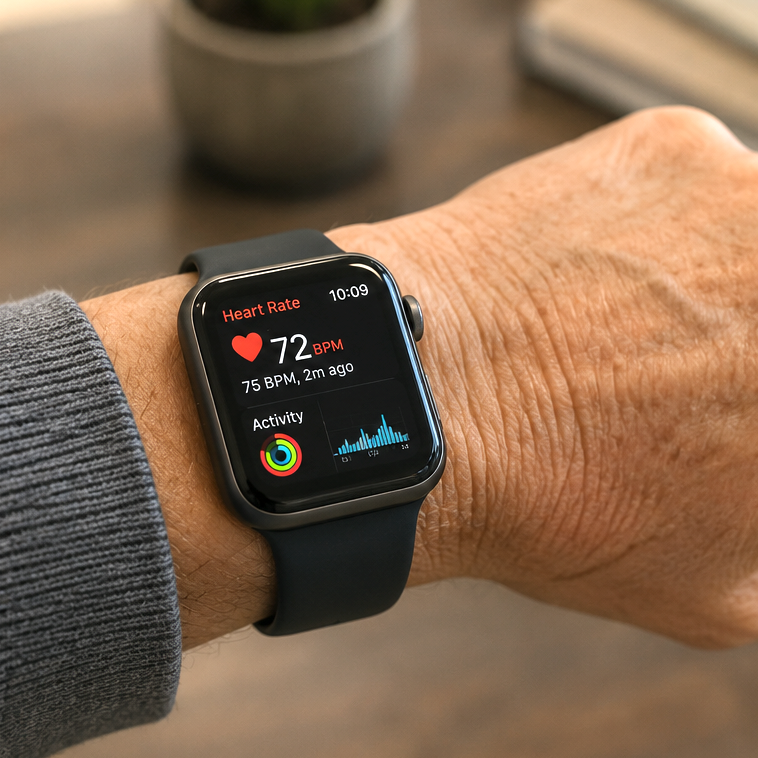
First, because AI systems will indeed have longitudinal relationships with all or most of us. An AI connected to a patient's wearables that have been monitoring vital signs, sleep and motion patterns, VO2 max, and more for months, years, or longer knows long before the patient gets to the waiting room that there is a problem. And has more useful data at its disposal than any physician could.
Longitudinal health partner
A small example. My 85-year-old mother lives in another city. Last month her Apple Watch — which along with her iPhone has been monitoring her movement for nearly a decade — alerted me that her daily steps and calories burned had been trending downward for several weeks. A quiet drift in her own baseline that no one in a clinic would have caught, because she hadn't made any appointment. I called her and found that she had hurt her ankle, hadn't mentioned it, and was starting to get back to her usual routine.
No visit needed. No doctor. No billing code.
Ofri's other argument is that AI cannot see what a physician sees across a waiting room. What she fails to recognize is that AI now sees what no physician ever sees: the slow daily drift of an octogenarian's activity, from hundreds of miles away.
Not to mention that LLMs can now literally see whatever you point the camera at, including how the patient is breathing.
Ofri's examples are not a refutation of AI capabilities in health. They are a description of them.
The first to go
Meanwhile, the bread-and-butter healthcare encounters are not the complex "Anna Karenina" case she describes. They are quick, transactional — and increasingly happening outside the clinic, the first to migrate.
The actual disruption underway does not require AI to "replace doctors", it just requires AI and other technologies to provide a solution outside the clinic for the many common reasons a patient shows up. Reassurance that a cough is just a cold, informed by a wearable showing normal heart rate and oxygen saturation. A photo of a rash or mole triaged by an AI visual model. Routine titration of a blood pressure medication or statin guided by a connected cuff and an AI that has the patient's daily readings.
Each time such a solution arises, an encounter — and the revenue attached to it — is pulled away from the doctor.
And as AI grows more capable and the data captured by our personal technologies becomes more comprehensible, better understood, and more effectively scaled throughout society, it will pull more and more sophisticated activities out.
It's already happening
This is not simply a theory. Gallup and West Health found that roughly 14 million U.S. adults skipped a provider visit after consulting an AI tool — a finding I unpacked here, pointing out that translates to 168 million missed appointments per year, completely invisible in claims data. Rock Health's 2025 Consumer Adoption Survey put consumer AI chatbot adoption at 32%, with 18% of users self-adjusting medications based on what the bot told them. And Ganguli and colleagues had already documented a 24% decline in primary care visits between 2008 and 2016 — three-quarters of which was invisible in standard claims data, and which they felt was at least partially due to patients using the internet to answer health questions.
This is the Monitoring Migration, the Knowledge Migration, the Diagnosis Migration — happening now, at scale, with or without anyone's permission. ChatGPT health answers the question. A wearable flags the arrhythmia. A DTC platform writes the GLP-1 prescription.
Ofri's essay does not engage with any of this. It can't, because the framing she has chosen assumes the patient is in the exam room to begin with. But a rapidly growing number of them are not.
Even the long relationship is at risk
The 25-year-relationship version of Ofri's argument might be slower to migrate: the patient she has known across two decades of clinic visits, whose gait and heart murmur and family crises she carries in her head.
But Ofri's assumption that long relationships and contextual wisdom are uniquely human territory just doesn't hold. The consumer tools assembling around this are not yet a single product, but the pieces are all shipping now: wearables capturing continuous physiology (Apple Watch, Whoop, Oura, Dexcom's OTC CGM), symptom and mood logs in Apple Health and dozens of apps, lab-trend services like Function Health, and conversational AI that now retains memory across sessions. The integration layer — one agent that synthesizes all of it into clinical reasoning about this specific person — is the obvious next product.
A patient running that near-future set of tools for a year is in a relationship, too. Their IT stack has continuous data, total recall, and no 15-minute visit cap. It knows when their resting heart rate drifted, how they slept the week of the family crisis, what their A1c trend looks like, and what they said about their estranged child eighteen months ago. Ofri's 25-year relationship is built on episodic snapshots a few times a year — quarterly at best, annual for most patients. The integrated consumer record will have minute-by-minute data over years. My mother's decade of Apple Watch data, captured without her ever thinking of it as a medical record, is already a longer continuous physiological dataset than any clinician's chart on her.
AI can't do X — except it can
It is worth noting how often the "AI cannot do X" argument has been wrong. Eric Topol's 2019 book Deep Medicineargued that AI would handle the data and free physicians for the human work AI could never do. For example, AI "cannot empathize with a patient." Then in 2023, Ayers and colleagues published a JAMA Internal Medicine study comparing ChatGPT and physician responses to real patient questions on Reddit's r/AskDocs. Blinded licensed clinicians preferred the chatbot's responses 79% of the time, rating them 3.6 times higher for quality and 9.8 times higher for empathy.
A 2025 replication in the Journal of General Internal Medicine found the same effect — and that chatbot responses scored higher on empathy even when evaluators were told the response came from a physician. By 2024, Topol's framing had inverted: at the Precision Med TRI-CON keynote, he described AI tools that coach physicians on empathy by flagging when they interrupted a patient after nine seconds or failed to show sympathy. To his credit, he updated his position publicly when the evidence shifted.
Getting back to Ofri, there is no obvious reason character understanding, longitudinal context, and clinical wisdom will be exempt from the same technological trajectory.
What's left for doctors
Ofri closes with a call to elevate the medical humanities — to teach the next generation wisdom rather than smarts, because "they can look up whatever they need to know." She is right that wisdom matters more than knowledge. She is most likely wrong that wisdom is the last stronghold for doctors because there is no reason to believe AI cannot gain wisdom (or the convincing appearance of it, as with empathy).
If AI eventually has the empathy, the knowledge, the wisdom, and the continuous data — then the work that most durably remains for physicians is not cognitive or relational. It is physical. Stabilizing a patient after a motor vehicle accident. Suturing a laceration. Setting a fracture. Delivering a baby. Administering anesthesia. Performing surgery. The work that requires hands on a body, in a room, in real time, with legal authority and procedural skill. The work that cannot be done from a phone, a wearable, or a chatbot, regardless of how sophisticated those tools become.
That is a much smaller share of what physicians currently do than the profession wants to acknowledge. It is also more generally defensible — and not because AI has reached some intrinsic limit on judgment or empathy. The physical category holds because dissolving it requires as-yet-unrealized advances not just in AI but in robotics.
How many physicians will we need?
The strawman is whether AI will replace doctors. The real question is how many physicians the system will need once the tasks only physicians can perform are dramatically reduced.
The cognitive and relational tasks are migrating to consumer AI, wearables, and DTC platforms. The empathy gap closed in under five years. The longitudinal record is being assembled outside the clinic. What remains is the physical work — stabilization, procedures, surgery — and a smaller tier of relational practice paid for directly by patients who want presence rather than throughput. Both categories are real. Neither is large enough to sustain the current physician workforce, the current hospital-system economics, the current training pipeline, or the current insurer business model.
So while that is the question Ofri's essay does not ask, it's the one our profession will not be able to avoid much longer.