Digital Coaches, Part III: FDA + Utah Accelerating the Consumer Health Shift
Yesterday (January 6, 2026), the FDA updated its General Wellness guidance. The change: consumer devices can now measure blood pressure, glucose, oxygen saturation, and other clinical parameters for wellness coaching—no FDA clearance required.
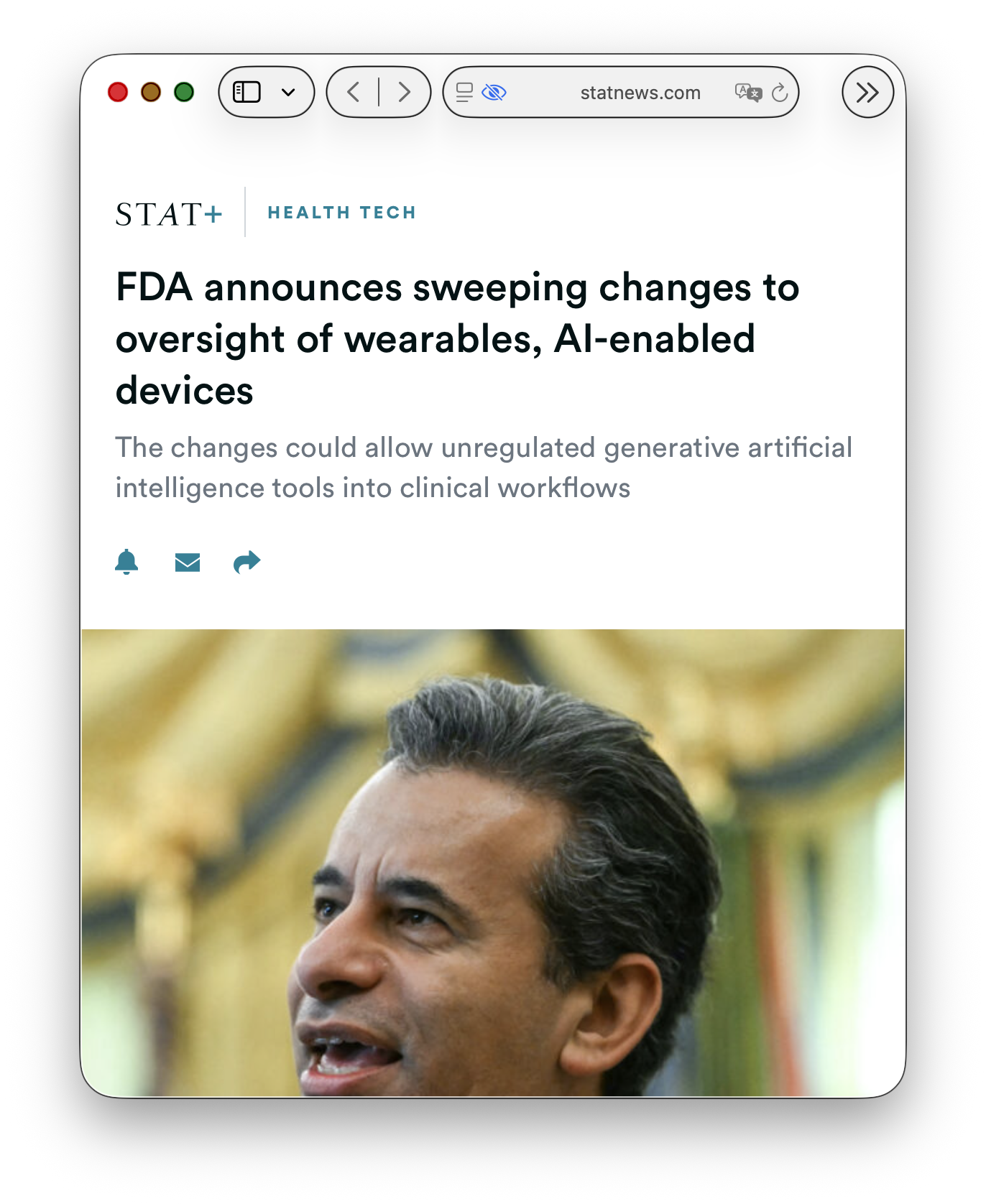
One more reason not to visit the regulator
The 2019 version of this guidance covered wellness claims but said nothing about devices that measure clinical parameters. The assumption at the time was simple: if you measure blood pressure or glucose, you're probably a medical device.
The 2026 update says: not if you're coaching for wellness. Measure anything you want non-invasively, provide detailed feedback, offer AI-driven recommendations—just don't claim to diagnose or treat disease.
In October, I wrote about digital health coaches—AI systems handling day-to-day interpretation, advice, and treatment adjustments that once required doctors. In November, I explored how that coaching is giving prevention a business model at global scale through devices like Apple Watch and Oura Ring.
Well, the FDA just gave those products an easier regulatory path for further innovation.
This matters because the wellness device market is enormous. Apple sold over 50 million Apple Watches in 2024. Dexcom has 1.6 million users. WHOOP, Oura, Levels, Ultrahuman—millions more. These companies can now measure clinical parameters and provide coaching without navigating medical device regulations.
One less reason to visit the regulator.
What Changed
The updated guidance expands what counts as "general wellness." It now explicitly covers non-invasive sensors that estimate physiologic parameters—as long as they're intended for wellness use only.
These devices can:
Display values, ranges, trends, or longitudinal summaries
Contextualize outputs in relation to sleep, activity, stress, recovery
Notify users when outputs fall outside ranges appropriate for wellness
They can't:
Claim clinical equivalence or medical/clinical grade accuracy
Provide alerts requiring specific clinical action
Offer treatment guidance for medical management
Reference diagnostic thresholds or specific diseases
A wearable that monitors pulse rate, blood pressure, sleep quality, and activity for "assessing recovery" qualifies as wellness—as long as it doesn't claim to diagnose hypertension or replace a medical device.
The Contradiction
There's an inherent tension in the new guidance: it says you can't claim to be treating disease. The problem is that although lots of "wellness" is marketing fluff, the core — exercise, sleep, and eating well — in fact IS treating disease.
For example, exercise is first line therapy for hypertension. So if a device measures your blood pressure, coaches you to exercise because it's trending upwards, and your pressure drops as a result . . . isn't that treating hypertension?
The FDA's answer: not if you don't claim it is.
You can say exercise "may help manage high blood pressure" but not "treats high blood pressure." The biological effect is identical. Only the framing differs.
This isn't limited to hypertension. Sleep coaching can lower diabetes risk—but don't call it diabetes prevention. Stress reduction improves cardiovascular outcomes—but don't call it cardiac therapy. Weight loss from activity tracking reduces joint pain—but don't call it osteoarthritis treatment.
Core wellness interventions certainly have medical effects, but the FDA is willing to pretend they don’t, in order to allow more innovation.
This works for now. It won't work forever. Consumer wellness tech advances faster than medical tech because more money and talent is going after it. As wellness devices get more sophisticated, it's likely that the treatment they offer will become more effective, and the gap between (for example) "wellness coaching that improves your blood pressure" and "treating hypertension" will be even smaller.
Utah and FDA: Two Parts of the Same Regulatory Story
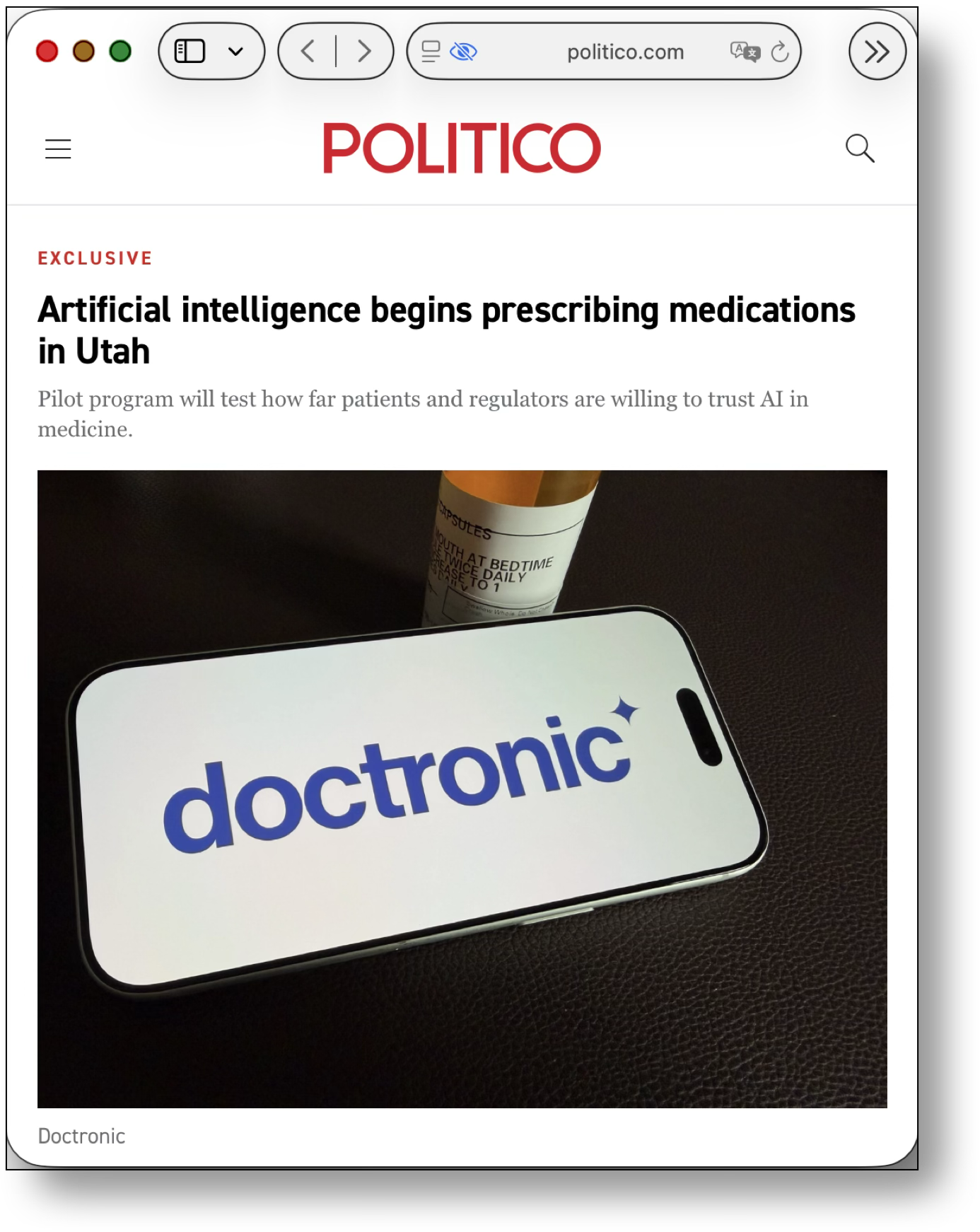
One more reason not to visit the doctor
The same week FDA released their wellness guidance, Utah became the first state to let AI renew prescriptions with no doctor involved.
Both are regulatory relaxation. Utah created a sandbox—temporarily relaxing laws to let companies practice medicine with AI. The FDA clarified that wellness devices measuring clinical parameters don't need permission at all.
Different mechanisms, same result: moving healthcare tasks out of traditional healthcare systems.
Utah's sandbox doesn't just apply to hospitals or traditional healthcare companies. It applies to DTC companies like Ro and pharmaceutical companies' direct-to-consumer efforts like Lilly Direct. These aren't healthcare systems—they're consumer companies that happen to deal with health.
By reducing doctor workload (no more refills to deal with), the UT rule means that fewer doctors will be required per unit of work. And who will be able to respond more quickly to that reduced requirement: traditional healthcare? Or DTC startups like Ro or DTC pharma like LillyDirect? Who will more quickly, and readily, reduce their physician staffing levels?
Obviously, the DTC companies will move faster. They're not built around physician labor. They're built around technology that replaces physician labor.
Traditional healthcare systems will debate AI's role in clinical workflows while consumer companies eliminate the workflows entirely.
Both the FDA guidance and Utah's sandbox accelerate the same trend: health moving to consumer channels where traditional healthcare can't follow.
The Bigger Picture
Health-relevant capabilities keep migrating from clinic to consumer. OTC drugs, home tests, smartphone diagnostics, now AI-powered wellness coaches with physiologic monitoring.
Each migration follows the same logic: if the task doesn't require medical judgment for safety (or no longer requires it), let tech-enabled consumers handle it themselves. And FDA's updated guidance plus Utah’s relaxed regulation just expanded the category of tasks that don't require medical judgment.
Healthcare systems worry about retail clinics and urgent care centers as competitors. The real competition is coming from devices that keep people out of healthcare entirely. Not by denying care, but by providing it elsewhere.
Utah's sandbox and FDA's guidance are both accelerating that shift. Both increase the number of things that don't require a human expert -- or a traditional healthcare system -- to provide. Both move healthcare tasks to consumer channels. Both reduce the need for traditional healthcare infrastructure.
The market is already moving. Utah and FDA just cleared the path a bit more.
This is the third piece in a series on digital health coaches, wearables, and consumerization of health. See also The Rise of Digital Health Coaches and Digital Coaches, Part II: Prevention's New Business Model.